Canada PR With a Low CRS Score: The Rural Route in 2027
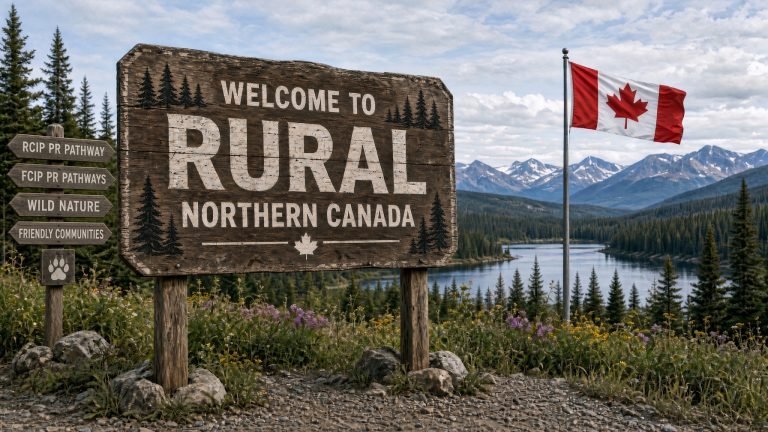
Zero general Express Entry draws in 895 days. Ontario pays 15 points for a northern postcode and zero for Toronto. Four rural communities will not score you at all.
Canada resettles refugees from abroad through government programmes and through ordinary people who agree to support a family for a year. Two of the three private routes are currently paused, so knowing which door is actually open matters before anyone raises money or makes a promise.


People frequently begin fundraising and making promises to a family abroad before checking whether the route is accepting applications. Start here instead.
Five or more Canadian citizens or permanent residents sponsoring a named refugee together. This is the route most ordinary community groups use, and it is currently closed to new named applications.
An organisation, association or corporation in the community sponsoring a named refugee. Paused on the same basis and the same timetable as Groups of Five.
Incorporated organisations, most often faith communities and ethnocultural associations, that hold a standing agreement with the government. This is the main route still open.
Two questions, and an honest answer including when the answer is that you cannot proceed right now.
Two questions. This tells you which route applies to your situation and whether it is currently accepting applications.
Sponsorship is a financial undertaking as well as a moral one. These are the published minimums, and they are a floor rather than a realistic budget.
This is the single most common reason a named private sponsorship application fails before anyone even assesses it, and it is entirely avoidable.
For a named Group of Five or Community Sponsor application, the refugee must provide a Refugee Status Determination document, meaning formal recognition as a refugee by the UNHCR or by a foreign government. Several documents that look official are not accepted, and the application is simply returned.
Check this before anything else. Families abroad frequently hold an asylum seeker certificate and reasonably believe it proves refugee status. It does not, for these purposes.
Referred by the UNHCR and supported entirely by the government on arrival, through the Resettlement Assistance Program.
Includes specific streams for women at risk, human rights defenders, and LGBTQI+ refugees through Rainbow Railroad.
A hybrid. The refugee is UNHCR-referred and already approved by Canada, and the cost is split between a private sponsor and the government.
The only private route currently open to Groups of Five and Community Sponsors, but very small.
Sponsors provide a full twelve months of income support and settlement help. The largest resettlement category by target.
Be honest with families about the wait. Three years is a long time to hold a promise.
Not right now, if you want to name that specific family and sponsor them yourselves. New Group of Five and Community Sponsor applications for named refugees have been paused since 29 November 2024, and the pause runs to 31 December 2026.
There is a well-established way around it that is entirely legitimate: work with a Sponsorship Agreement Holder. These are incorporated organisations, often faith communities, that hold a standing agreement with the government and can still submit applications. Many take on community groups as constituent groups or co-sponsors, where your group provides the money and the day-to-day support and they hold the formal sponsorship.
The constraint is their allocation. The 2026 national cap is 5,000 people and individual allocations are not published, so ask early what space they actually have.
Please do not fundraise or promise anything to a family abroad before confirming a route. We have seen the harm that causes on both sides.
For a full private sponsorship covering twelve months, the published figures are $21,400 for one person, $29,900 for two, $34,100 for four, and $38,100 for six, with roughly $3,000 for each additional person. Blended visa office-referred sponsorships are about half that, because the government funds six of the twelve months.
Three warnings matter more than the numbers. The published table is a national average used at application stage only, and your real liability is set by local rates where the family will settle, so it can be higher. Borrowed money is not accepted, whether from a line of credit, a loan or a second mortgage. And linked applications are costed separately rather than combined.
The money is also only half the commitment. You are agreeing to twelve months of practical support: finding housing, enrolling children in school, health cards, banking, language classes, and simply being available.
You cannot apply for Canadian resettlement yourself. There is no form, and anyone who offers to add your name to a list for money is not being honest with you. Referrals cannot be bought.
There are three genuine routes. Register with the UNHCR or the relevant authority where you are, because government-assisted resettlement flows almost entirely from UNHCR referral. Be matched with a private sponsor in Canada, which currently means a Sponsorship Agreement Holder. Or, if you have close family in Canada, look at family sponsorship, which is a different programme and often much faster.
Keep your Refugee Status Determination document safe, and understand that a UNHCR asylum seeker certificate or registration document is not the same thing and will not be accepted for a named sponsorship.
Longer than most groups expect, and this is worth being honest about with the family before anyone commits.
As at 31 January 2026, IRCC reported about 18 months for government-assisted cases and about 38 months for privately sponsored ones. There is no service standard for the resettlement programme at all, and IRCC has said it is developing one following an Auditor General recommendation.
Country of processing makes an enormous difference. Government-assisted times have ranged from around 7 months in Thailand to nearly 5 years in some offices. Ask what is realistic for the region in question rather than assuming an average applies.
Plan for the family's circumstances to change over three years. Children turn 22, marriages happen, people move country. Each of those can affect an application already in the queue, so tell your representative promptly.
Several things, and not in a generous direction.
Groups of Five and Community Sponsors have been paused for named applications since November 2024, now extended to 31 December 2026. New Sponsorship Agreement Holder intake is closed for 2026, so no new organisations can join. The Economic Mobility Pathways Pilot, which let refugees immigrate through work skills rather than protection, stopped accepting applications on 31 December 2025 with no announced resumption.
The Blended Visa Office-Referred target for 2026 is just 50 people nationally, which is effectively symbolic.
Two things went the other way. The Rainbow Refugee Assistance Partnership for LGBTQI+ refugees was extended to 31 December 2029. And separately from the levels plan, around 115,000 protected persons already in Canada are being transitioned to permanent residence across 2026 and 2027.
Yes, in a way that matters here. Quebec runs its own immigration selection under the Canada and Quebec Accord, including for refugees selected abroad.
Quebec's collective sponsorship programme is suspended, and the suspension runs to 31 December 2029. That is a far longer closure than the federal pause on Groups of Five, and it catches many Quebec community groups by surprise. Existing eligible undertakings continue to be examined, and adding dependants is unaffected.
For refugees already recognised inside Canada, Quebec is actually increasing its intake. Its 2026 plan targets 4,800 to 5,100 admissions of people recognised on site, the one category it is expanding.
If the family will settle in Quebec, the rules and the timelines are different enough that you should check before assuming anything on this page applies.
Sponsorship pauses, caps and funding tables change with little notice. Follow our journal so your group is not caught out mid-application.

Zero general Express Entry draws in 895 days. Ontario pays 15 points for a northern postcode and zero for Toronto. Four rural communities will not score you at all.


Manitoba issued 474 Letters of Advice to Apply on 24 September 2026, with 417 going to engineering, architecture and IT candidates at a cut-off of 760. The more useful detail is why eligible candidates were skipped – and what the Workforce Transition Bridge means for those who were not invited.

Newfoundland and Labrador invited just 62 people on 18 September, down from rounds of 400 earlier this year. The draw size is not the story. The temporary federal measure letting PNP nominees bridge without an AOR is, and it expires on 31 December 2026.

Sponsorship pauses, caps and funding tables change with little notice. Follow our journal so your group is not caught out mid-application.