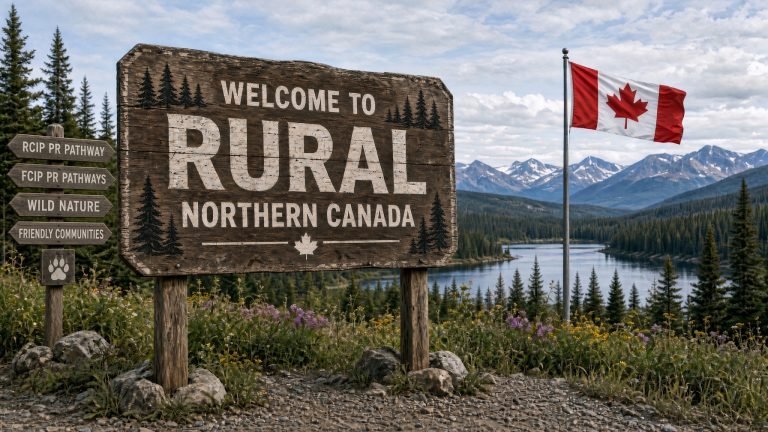
Canada PR With a Low CRS Score: The Rural Route in 2027
Zero general Express Entry draws in 895 days. Ontario pays 15 points for a northern postcode and zero for Toronto. Four rural communities will not score you at all.
Getting the visa is the beginning. The first ninety days decide how the next five years feel. Much of the help you need is free, and we will tell you exactly where to get it, including when that free help is better than anything we could sell you.


The government funds more than a billion dollars of free settlement help a year. We would rather send you there than sell you something you can get for nothing. The rules changed on 1 April 2026 and most people affected were never told.
The government funds a great deal of free help, but not for everyone, and the rules changed on 1 April 2026. This tells you honestly whether you qualify. Nothing you enter is sent anywhere.
Economic programmes include Express Entry, provincial nominee, RCIP, Atlantic, start-up visa and the pilots.
Use the “Became P.R. on” date printed on your Confirmation of Permanent Residence.
Sequence matters more than speed. Almost nothing works before the social insurance number, and the slowest items are the ones people leave until last. Tick these off as you go.
Sixteen steps, in the order that actually works. Your ticks are stored in your own browser and are never sent to us. Amounts and rules verified against Government of Canada and Government of Ontario sources in September 2026.
Canada funds more than a billion dollars a year of settlement services through over 530 organisations. If you are eligible, this is genuinely good help and it is free.
Our work is regulated immigration advice. Some of it touches settlement, and it is chargeable, set out in a written retainer before we start.
The funded settlement provider for our city is the Sault Community Career Centre on Queen Street East. They deliver needs assessments, free LINC language classes, employment and credential support, settlement workers in schools, and the Resettlement Assistance Programme for government-assisted refugees.
They also run a programme worth knowing about if the federal rules exclude you: Newcomer Settlement and Language Training, which is free and expressly serves international students and temporary foreign workers. That is the group most often turned away elsewhere.
You can also search every funded service in the country on IRCC’s own tool at the newcomer services finder. We have no commercial relationship with any of these organisations.
Advice matters, but so does a lift from the airport. These are the three practical things newcomers to Sault Ste. Marie ask us for most often, and we provide them for a fee that is quoted up front.
Someone is there when you land. After a long flight, with luggage, children and a phone that does not yet work, this is the difference between arriving and coping.
Your social insurance number unlocks almost everything else, and almost nothing works before it. We take you there and make sure you leave with it.
A small thing that people remember years later. Unfamiliar shops, unfamiliar brands, no car, and a family who need to eat tonight.
These are practical services, not immigration advice. They do not require a licensed consultant, and we describe them separately for that reason. They are also entirely optional, and nothing about your immigration matter depends on taking them.
Fees are quoted before we book anything, so you know the cost in advance and there are no surprises on arrival. Availability depends on your flight time and where you are settling, so tell us your arrival details as early as you can.
If a free service can do what you need, we will say so. Government-assisted refugees, for example, already receive airport reception and initial support through the Resettlement Assistance Programme, delivered locally by the Sault Community Career Centre, and should use that rather than pay us.
For most newcomers, yes, and it is properly funded. IRCC spent $1.125 billion in 2025 to 2026 on settlement services delivered by more than 530 organisations across Canada, plus a separate programme for government-assisted refugees.
That buys needs assessments, free language classes, employment and credential help, settlement workers in schools, community connections, and support services like childcare, interpretation and transport so that people can actually attend.
Two honest caveats. Eligibility is narrower than people assume, and funding is falling: the budget drops to about $935.7 million in 2026 to 2027, a cut of roughly 9.5%. IRCC shared reduced amounts with providers in February 2026. Expect longer waiting lists, and book early rather than at the point of crisis.
More people than expected, and this catches many by surprise.
Canadian citizens are excluded outright, regardless of how or when they became a permanent resident. International students and most work permit holders are excluded. Refugee claimants are excluded until they receive a positive decision, at which point they become protected persons and are eligible.
The exceptions among temporary residents are narrow: participants in the Rural Community, Francophone Community, Atlantic and Rural and Northern pilots, and their families, are eligible even though they are not yet permanent residents.
If you fall outside, free options still exist. Ontario funds adult English and French classes through school boards with much broader eligibility, and in Sault Ste. Marie the Newcomer Settlement and Language Training programme serves international students and temporary foreign workers at no cost.
A significant change that very few people heard about. IRCC announced on 10 March 2026 that economic-class permanent residents can now use federally funded settlement services only for a limited period.
The limit is six years from the date you became a permanent resident, dropping to five years for anyone landing on or after 1 April 2027. It applies to your spouse or partner and dependent children too, if they were on the same application.
Crucially, it is retroactive. IRCC applies it to everyone, including people who became permanent residents long before the rule existed. Their own worked example is blunt: if you became a permanent resident on or before 1 April 2020 through an economic programme, your access ended on 1 April 2026.
The clock runs from the “Became P.R. on” date printed on your Confirmation of Permanent Residence. It applies to Express Entry, provincial nominee, the Rural Community and Atlantic pilots, start-up visa and the rest. It does not apply to family sponsorship, refugees or protected persons.
No. Ontario removed the three month waiting period for OHIP in March 2020 and it has not come back. The province states plainly that if you are eligible, coverage is immediate and you can apply as soon as you arrive.
Three things trip people up. You must apply in person at a ServiceOntario centre. You need three separate original documents: proof of status, proof of Ontario residency and proof of identity. And photocopies are refused, so bring originals.
You also need to satisfy the residency tests, which include being physically in Ontario for at least 153 of your first 183 days, and Ontario being your primary home.
Permanent residents qualify. So do protected persons, and work permit holders working full time for an Ontario employer for at least six months, whose spouse and dependants may then qualify too.
This is the hardest and slowest part of settling, and it is worth separating two things that sound similar.
An educational credential assessment is an immigration document that tells IRCC what your foreign credential is worth in Canadian terms. IRCC states clearly that it does not guarantee you a licence to practise. It costs roughly $200 to $265 through the designated organisations.
Licensure is separate, provincial, and run by the regulator for your profession. Different body, different evidence, different timeline. Ontario regulates over a hundred professions and trades.
Two things in your favour in Ontario. Since December 2021 a regulated profession cannot require Canadian experience as a qualification for registration, and non-compliant requirements were deemed void from December 2023. And the Ontario Bridge Training Program offers occupation-specific training and licensing exam preparation, with a bursary of up to $5,000 available through the institution.
Federal loans of $15,000 to $30,000 also exist for exam fees, training and tuition through designated lenders.
More than most newcomers realise, and it depends on filing a tax return even if you earned nothing.
The Canada Child Benefit pays up to $8,157 a year for each child under six and $6,883 for ages six to seventeen, at the full rate below an adjusted family net income of $38,237. Apply on form RC66 with proof of birth.
The old GST credit was renamed the Canada Groceries and Essentials Benefit from July 2026 and pays $445 per adult and $234 per child under nineteen, quarterly. New residents apply on form RC151 before their first return.
In Ontario the Trillium Benefit adds a sales tax credit of up to $378 each and an energy and property tax credit of up to $1,307. If you settle in the Algoma district, which includes Sault Ste. Marie, you also qualify for the Northern Ontario Energy Credit of up to $189 single or $290 family.
All of it requires a social insurance number and a filed return. File by 30 April, every year, even with no income.
Settlement eligibility, benefit amounts and provincial rules changed repeatedly through 2026, mostly without individual notice. Follow our journal so you are not the last to know.

Zero general Express Entry draws in 895 days. Ontario pays 15 points for a northern postcode and zero for Toronto. Four rural communities will not score you at all.


Manitoba issued 474 Letters of Advice to Apply on 24 September 2026, with 417 going to engineering, architecture and IT candidates at a cut-off of 760. The more useful detail is why eligible candidates were skipped – and what the Workforce Transition Bridge means for those who were not invited.

Newfoundland and Labrador invited just 62 people on 18 September, down from rounds of 400 earlier this year. The draw size is not the story. The temporary federal measure letting PNP nominees bridge without an AOR is, and it expires on 31 December 2026.

Settlement eligibility, benefit amounts and provincial rules changed repeatedly through 2026, mostly without individual notice. Follow our journal so you are not the last to know.