The Rural Community Immigration Pilot is no longer a pilot. The name has not caught up yet, and IRCC still uses it on canada.ca, but the law underneath it changed on 22 October 2026.
On that date the Governor in Council registered SOR/2026-217, which creates a rural community immigration class inside the Immigration and Refugee Protection Regulations. It was published two weeks later in the Canada Gazette, Part II, Volume 160, Number 22. There was no press conference. For a change this significant to rural immigration, it arrived very quietly.
This article sets out what actually changed, the transition dates that matter if you are already in the system, and the parts of the new rules that will catch people.
Why the word pilot was never just branding
A pilot in Canadian immigration is not a casual label. It describes the legal instrument that created it.
The Rural and Northern Immigration Pilot was launched in 2019 under section 14.1 of the Immigration and Refugee Protection Act. That section lets the Minister issue instructions creating a class of permanent residents, but only for a limited duration of five years. After that it lapses unless something replaces it.
Everything downstream inherited that time limit. Communities could only plan in short blocks. Employers weighed whether designation was worth the effort for a route that might not exist by the time they used it. And applicants asked us the same question constantly: will this still be here when I get through it?
For seven years the honest answer was that it probably would be, but nobody could promise it. That is no longer the position. A prescribed class in the Regulations has no expiry date and needs no renewal.
How we got here
| When | What | Legal footing |
|---|---|---|
| 2019 | Rural and Northern Immigration Pilot (RNIP) launched | Ministerial instructions under section 14.1, five year ceiling |
| December 2024 | Rural Community Immigration Pilot launched | Ministerial instructions, explicitly an interim measure to bridge the gap after RNIP while a permanent program was designed |
| 22 October 2026 | Rural community immigration class created | SOR/2026-217, written into the Regulations at section 87.4. In force on registration |
The regulatory impact statement is unusually direct about this. It describes the December 2024 pilot as an interim measure launched to bridge a service gap while work continued on a permanent community based immigration program. The pilot was always scaffolding. This is the building.
The new class now sits in paragraph 70(2)(b) of the Regulations alongside the federal skilled worker class, the Canadian experience class, the provincial nominee class and the Atlantic immigration class. It is an economic class like any other.
The transition, and the dates that matter most
This is the section to read if you already hold a recommendation, or are waiting on one. The transitional provision in the Regulations is one sentence and it is strict:
A certificate of recommendation issued under the December 2024 Ministerial Instructions cannot be used to satisfy paragraph 87.4(2)(b) of the Immigration and Refugee Protection Regulations.
Read alone, that sounds like everyone holding a pilot recommendation has been stranded. They have not. The transition plan keeps the old door open, with a closing date.
| Date | What happens |
|---|---|
| 31 December 2026 | Communities finalise all remaining recommendations under the pilot |
| 1 January 2027 | Allocations move to the new program and communities begin issuing recommendations under it |
| 30 June 2027 | The pilot ministerial instructions remain in force until this date. If you were recommended under them, you can still apply to IRCC under the pilot |
IRCC states the intent plainly: to let candidates apply under the program eligibility they were assessed for at the recommendation stage. So the two regimes run in parallel for a window, and your recommendation determines which door you use.
The practical advice is the opposite of what the transitional provision suggests on first reading. If you hold a pilot recommendation, do not abandon it and chase a new one. File under the pilot, and do it well before 30 June 2027.
Recommendation validity has doubled
Under the pilot, a community recommendation was valid for six months. Under the new program, section 87.44(6) says a certificate is valid until the earlier of the first anniversary of the day it was issued, or the day the economic development organization revokes it.
Twelve months instead of six is a meaningful change. It gives applicants room to assemble police certificates, medicals and credential assessments without the recommendation expiring underneath them. The six month validity is also why 30 June 2027 was chosen as the cut off: recommendations finalised by 31 December would otherwise expire around then.
The 14 designated communities
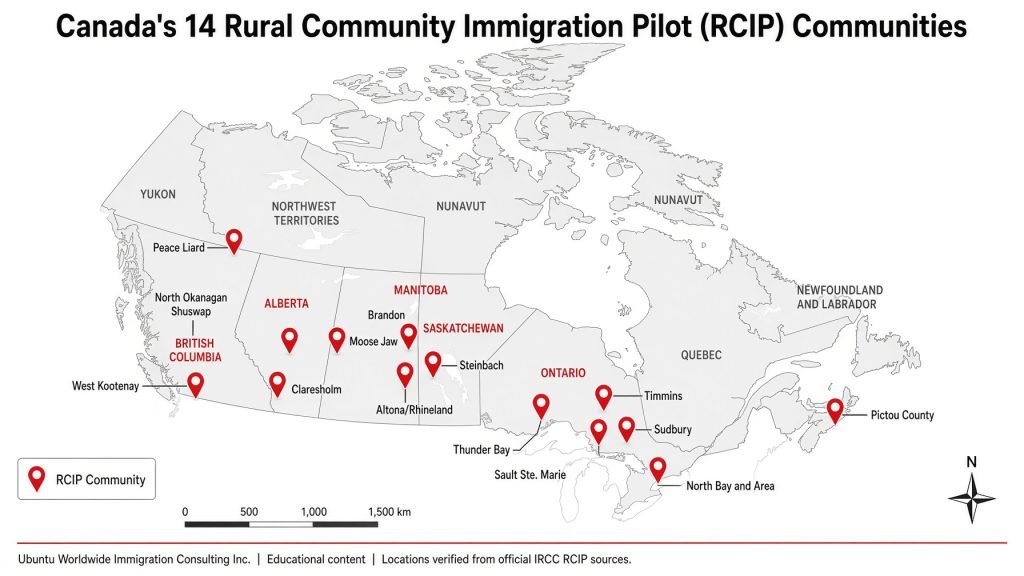
The route only exists inside communities the Minister has designated. As at 5 November 2026, IRCC lists these 14 rural communities.
| Province | Designated communities |
|---|---|
| Ontario | Sault Ste. Marie, Greater Sudbury, Timmins, North Bay and Area, Thunder Bay |
| Manitoba | Brandon, Steinbach, Altona and Rhineland |
| British Columbia | West Kootenay, North Okanagan Shuswap, Peace Liard |
| Alberta | Claresholm |
| Saskatchewan | Moose Jaw |
| Nova Scotia | Pictou County |
IRCC describes 18 participating communities in total. That figure covers these 14 rural communities plus six Francophone communities under the Francophone Community Immigration Pilot, with Greater Sudbury and Timmins appearing on both lists. That overlap is why the numbers never add up the way people expect.
The boundary is a map, not a town name
To qualify you must intend to live inside the geographic boundaries of the designated community, and hold that intention from the day you apply until the day you become a permanent resident. Boundaries are published as maps, and the names mislead.
North Bay and Area is not only North Bay. West Kootenay and Peace Liard are regions covering many towns. Altona and Rhineland is two places treated as one community. A job a short drive outside the line is outside the community, and the drive does not matter.
Before you accept any offer, open that community boundary map and find the employer address on it. IRCC publishes an interactive map covering all of them. This single check saves more wasted months than anything else on this page.
How a community gets designated
Under section 87.41 the Minister may designate a community outside Quebec if it is rural, weighing its economic circumstances, its capacity to welcome and settle newcomers, and its administrative capacity to run the program. Designated communities are published on the Department website and the list can change.
That is worth understanding properly. A community is not on the list because it wants workers. It is there because it demonstrated it can receive them, with the housing, schools and settlement services that implies.
Who decides what, and in which order
The most common misunderstanding about this route is that you apply to it. You do not, at least not at the start. The order runs like this.
| Step | Who acts |
|---|---|
| 1 | The Minister designates the community |
| 2 | The Minister designates that community economic development organization, its EDO |
| 3 | The EDO publishes a priority sectors and occupations list, and must review and resubmit it to the Minister every year or lose its designation |
| 4 | The EDO designates employers who meet the criteria |
| 5 | A designated employer makes you an offer, then applies for your certificate of recommendation |
| 6 | Only then do you apply to IRCC for permanent residence |
Note step five. Under section 87.44 the employer applies for the certificate with respect to you. You cannot approach the economic development organization and request one yourself, and a great many people waste weeks trying.
What a designated employer has to prove
Section 87.43 is not discretionary. An EDO must designate an employer that applies and meets all of the criteria, which include:
| Requirement | Detail |
|---|---|
| A genuine business | Either operating in the community under the same ownership for at least two years, or operating anywhere and making a substantial contribution to the community economy |
| On the priority list | Carrying on business in at least one sector or occupation on that community list |
| Training completed | A representative who has completed intercultural competency training and onboarding training |
| A settlement commitment | A commitment to support the settlement of the worker and any accompanying family, including facilitating access to settlement support |
| Clean on worker protection | Not in contravention of worker protection laws |
A designation can be revoked for misrepresentation, for a penalty under the employer compliance regime, or for a finding of non compliance with worker protection laws. If an employer designation is revoked, the EDO must revoke any certificate of recommendation that rested on an offer from that employer.
Three rules that exist to protect applicants
These are easy to miss in a long instrument, and each one is useful to know.
Nobody can charge you for a recommendation. To keep its designation, an economic development organization must not charge fees for designating or revoking an employer, or for issuing, amending or revoking a certificate of recommendation. If anyone asks you to pay for a community recommendation, that request is itself the answer.
Your wage has a floor. A qualifying offer must pay at least the highest of the applicable minimum wage, the bottom of the Job Bank wage range for that occupation, and any higher figure the EDO has set based on the local labour market.
Your consultant cannot be your employer. A business owned in whole or in part by a lawyer, a Quebec notary, or a licensee of the College of Immigration and Citizenship Consultants providing immigration services cannot be a designated employer. Nor can a business that recruits people into a pool to be contracted out to others.
Who qualifies under the new class
Section 87.4(2) sets out the requirements, and you must meet every one of them from the date you apply until you obtain permanent resident status, not merely on the filing date.
| Requirement | What it means |
|---|---|
| Intent to reside | Inside the geographic boundaries of a designated community |
| Certificate of recommendation | Valid, issued by the designated economic development organization |
| Work experience | One year, matched to the TEER of the job offer. See the table below |
| Job offer | An eligible offer meeting section 87.46 |
| Education | A Canadian credential, or a foreign credential at least equivalent to a Canadian secondary school diploma plus an equivalency assessment less than five years old |
| Language | An approved test less than two years old, meeting the Minister threshold in each of the four skill areas |
| Settlement funds | Half the low income cut off figure for rural areas outside census metropolitan areas and agglomerations, sized to your whole family. Not required if you are authorized to work and already working in Canada |
| Status | If you are in Canada, valid temporary resident status |
The work experience ladder
You need at least one year of full time work, or the part time equivalent, acquired in the three years before you apply. Which occupations count is determined by the TEER category of the job you have been offered, not the other way round.
| If the job offer is in | Your experience must be in |
|---|---|
| TEER 0 or 1 | TEER 0, 1, 2 or 3 |
| TEER 2 | TEER 1, 2, 3 or 4 |
| TEER 3 or 4 | TEER 2, 3 or 4 |
| TEER 5 | The same NOC unit group as the offer |
| NOC 33102 or 44101 | NOC 31301, or TEER 2, 3 or 4 |
The experience must include performing the lead statement and a substantial number of the main duties for that occupation as set out in the National Occupational Classification. Listing a job title is not enough.
One quiet provision that protects families
New subsection 25.1(5.1) sets the age lock in date for a dependent child at the day the application for a certificate of recommendation is made to the economic development organization, not the day you file for permanent residence.
For a family with a child approaching 22, that difference can be many months of protection, and it is the sort of detail that decides whether a child is included.
How many places the route actually gets
The 2027 to 2029 Immigration Levels Plan, published on 5 November 2026, gives the rural route its own line, and names it the Rural Community Immigration Program rather than a pilot.
| Year | Target admissions | Range |
|---|---|---|
| 2027 | 5,500 | 4,000 to 6,500 |
| 2028 | 6,000 | 5,000 to 7,000 |
| 2029 | 6,500 | 4,000 to 7,000 |
IRCC notes that this line covers remaining applications under both the RCIP and RNIP pilots, which continue to be processed to completion, as well as future admissions under the new program. So the places available to new applicants in 2027 are fewer than 5,500.
For context, the same plan holds overall permanent resident admissions at 380,000 a year across all three years, with the Provincial Nominee Program at 95,000 and federal high skilled at 100,000. Rural is a small, targeted route. Its advantage has never been volume. It is that the competition inside a single community is a fraction of the competition inside Express Entry.
What to do now
If you hold a recommendation issued under the pilot. File under the pilot. The instructions remain in force until 30 June 2027 and your recommendation was assessed against that eligibility. Do not let it lapse while you wait for something new.
If you are negotiating a job offer. Check three things before you accept anything: that the employer address falls inside the community boundary map, that your occupation appears on that community priority list, and that the employer is actually designated rather than merely willing to be.
If you are choosing between communities. Compare priority lists and intake patterns, not just the size of the town. A community whose priority list includes your occupation is worth more to you than a larger community where it does not appear.
If you ruled this route out because it was temporary. Look again. That objection no longer holds.
Common questions
Is RCIP still called a pilot? IRCC still uses the Rural Community Immigration Pilot name on canada.ca, and the community list still appears under the pilots heading. The legal instrument underneath it is now a permanent class in the Regulations, and the Immigration Levels Plan refers to the Rural Community Immigration Program.
Does my pilot recommendation still work? Not for the new class. It can still be used to apply under the pilot ministerial instructions, which remain in force until 30 June 2027.
How long is a recommendation valid now? Twelve months from the day it is issued, or until the economic development organization revokes it, whichever comes first. Under the pilot it was six months.
Can I apply for a recommendation myself? No. A designated employer applies for the certificate with respect to you.
Should I pay a community for a recommendation? No. An economic development organization that charges fees for issuing a recommendation cannot keep its designation.
Is Sault Ste. Marie still a designated community? Yes. Sault Ste. Marie remains one of the 14 designated rural communities. Intake windows are a separate question from designation, and we track those on our Sault Ste. Marie RCIP page.
Sources
Every figure and rule above was read directly from the primary sources on 5 November 2026: SOR/2026-217 in the Canada Gazette, Part II, Volume 160, Number 22, the IRCC participating communities list, and the Supplementary Information for the 2027-2029 Immigration Levels Plan.
General information only, current on 5 November 2026, and not legal advice. Designated communities, priority lists and intake windows change without notice. Confirm every detail with the community and on canada.ca before acting, and speak with a Regulated Canadian Immigration Consultant about your own situation. No recommendation, invitation or permanent residence outcome is guaranteed.
Reviewed by Mary Unogwu Ogenyi-Igoche, RCIC-IRB R731653, Ubuntu Worldwide Immigration Consulting Inc., regulated by the College of Immigration and Citizenship Consultants.